





Request PSIM Invoice
Your application has been approved
Once your request is submitted, an invoice will be issued and your place will be reserved upon payment. We’ll then provide full program details, session access, and onboarding information in July ahead of the start date.
What you’ll gain from the accreditation
- A practical, integrated investigation method aligned to WHS and HR/IR requirements
- Tools to identify root causes and systemic psychosocial hazards
- Capability in trauma-informed, person-centred investigation approaches
- Structured methods for risk assessment, reporting, and follow-up
- Access to tools, templates, and a peer learning environment
A few important notes
- Access to purchase is limited to approved internal professionals only
- Tickets are not available to consultants or students
- Places are limited and may be allocated on a first-confirmed basis
- (For the virtual option) Online training is delivered via Teams over 12-weeks with recordings available following each of the four seminars
Trusted Partner of Leading Organisations


Register Now
Choose Your City and Secure Your Place
Choose to attend in person in select cities or join online from anywhere. This training is available to internal professionals only. Check out our upcoming dates and reserve your place.
Online: Cohort 2 commences 23 October
4 online sessions across 6 weeks
Melbourne: 27-28 October
Mantra, Southbank Melbourne
Sydney: 23-24 November
Vibe Hotel, Sydney
Perth: March 2-3
The Hub, Bentley
Brisbane: March 11-12
Marriott Hotel, Brisbane
Melbourne: March 15-16
Rydges, Melbourne
Sydney: March 18-19
Vibe Hotel, Sydney
Testimonials
Practical Training Backed by Real-World Experience
FlourishDx training is trusted by organisations looking for practical, credible capability building — not just theory, but guidance participants can apply straight away.
Trusted by Teams Across Australia
Supporting Investigation Capability Across Leading Organisations
FlourishDx has helped organisations build stronger capability in psychosocial safety investigations through practical, applied training designed for real-world workplace complexity.






FAQs
Still Have Questions?
If you didn’t find what you were looking for, we’re here to help. Reach out to our team for tailored support or additional information about FlourishDx and how we can meet your needs.
Who is this training designed for?
This training is designed for professionals involved in leading, supporting, or overseeing workplace investigations involving psychosocial safety issues. This includes WHS, HSE and psychosocial safety professionals, HR and People & Culture leaders, industrial and workplace relations specialists, leaders with operational responsibility for investigations, and consultants or advisors conducting investigations. It is especially relevant for those looking to apply a more structured, repeatable, and defensible methodology to psychosocial safety matters.
Do I need prior investigation experience?
Some prior exposure to investigations or complaints handling is recommended. The PSIM Framework and Accreditation Training is not intended as a basic introduction to psychosocial safety. It is best suited to participants who already have some involvement in investigations and want a clearer methodology, stronger decision-making tools, and a more integrated approach to psychosocial matters.
What makes psychosocial safety investigations different?
Psychosocial safety investigations are often more sensitive, complex, and systemically influenced than traditional misconduct or physical incident investigations. The PSIM Framework is designed to help investigators go beyond fact-finding alone by applying a risk-based, person-centred, trauma-informed, fair, and strategically focused approach. That means considering not only what happened, but also the broader work design, organisational context, contributing factors, and ongoing risk of harm.
While ICAM can be useful for some physical incident investigations, it is not specifically designed for psychosocial matters. The PSIM Framework and Accreditation Training is built specifically for psychosocial safety investigations, making it better suited to issues involving cumulative harm, interpersonal dynamics, and broader organisational drivers.
Is this workshop available online as well as in person?
Yes. Participants can attend the PSIM Framework and Accreditation Training in person in selected cities or join an online cohort from anywhere. The online program is delivered across 4 sessions over 12 weeks, making it a flexible option for those who cannot attend face-to-face while still providing access to the same practical methodology, applied learning, and structured investigation framework.
Will I receive a certificate of competence following training?
Following training, there is a short competence assessment activity for participants to do in their own time. Satisfactory completion of this assessment is required to receive the accreditation certificate that certifies that the participant can competently apply the PSIM framework for a psychosocial safety investigation.
What will participants take away from the training?
Participants leave with a practical psychosocial safety investigation framework they can apply immediately, greater confidence in making proportionate and risk-based decisions, and hands-on skills for interviewing, analysing evidence, and reporting findings. They also receive a practical investigation toolkit that includes resources such as triage tools, planning templates, interview guides, analysis frameworks, reporting templates, and follow-up resources to support real-world application. Participants will also receive a certificate of completion for the PSIM Framework and Accreditation Training.
Is the training interactive?
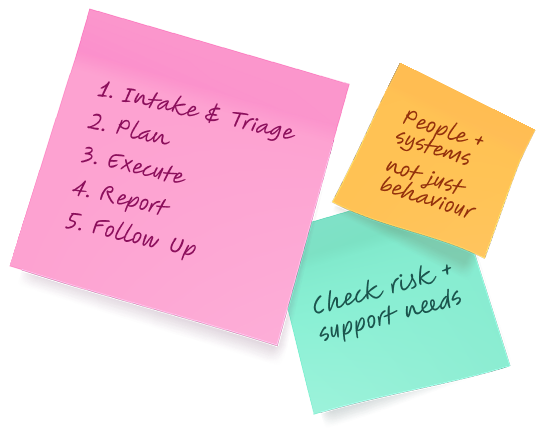
Yes. The training is designed to be highly interactive and hands-on. Participants work through realistic scenarios, applied exercises, and practical decision-making activities across the full investigation lifecycle, from intake and triage through to analysis, reporting, and follow-up. It is built to develop real capability, not just procedural awareness.
Can this workshop be delivered privately for our organisation?
Yes. The PSIM Framework and Accreditation Training can be a strong fit for organisations looking to build more consistent internal capability, strengthen governance, and create a clearer shared methodology for psychosocial safety investigations. Private delivery can also support cross-functional alignment between WHS, HR, People & Culture, Employee Relations, and leaders involved in investigation processes.
Who is this training designed for?
This training is designed for professionals involved in leading, supporting, or overseeing workplace investigations involving psychosocial safety issues. This includes WHS, HSE and psychosocial safety professionals, HR and People & Culture leaders, industrial and workplace relations specialists, leaders with operational responsibility for investigations, and consultants or advisors conducting investigations. It is especially relevant for those looking to apply a more structured, repeatable, and defensible methodology to psychosocial safety matters.
Do I need prior investigation experience?
Some prior exposure to investigations or complaints handling is recommended. The PSIM Framework and Accreditation Training is not intended as a basic introduction to psychosocial safety. It is best suited to participants who already have some involvement in investigations and want a clearer methodology, stronger decision-making tools, and a more integrated approach to psychosocial matters.
What makes psychosocial safety investigations different?
Psychosocial safety investigations are often more sensitive, complex, and systemically influenced than traditional misconduct or physical incident investigations. The PSIM Framework is designed to help investigators go beyond fact-finding alone by applying a risk-based, person-centred, trauma-informed, fair, and strategically focused approach. That means considering not only what happened, but also the broader work design, organisational context, contributing factors, and ongoing risk of harm.
While ICAM can be useful for some physical incident investigations, it is not specifically designed for psychosocial matters. The PSIM Framework and Accreditation Training is built specifically for psychosocial safety investigations, making it better suited to issues involving cumulative harm, interpersonal dynamics, and broader organisational drivers.
Is this workshop available online as well as in person?
Yes. Participants can attend the PSIM Framework and Accreditation Training in person in selected cities or join an online cohort from anywhere. The online program is delivered across 4 sessions over 12 weeks, making it a flexible option for those who cannot attend face-to-face while still providing access to the same practical methodology, applied learning, and structured investigation framework.
Will I receive a certificate of competence following training?
Following training, there is a short competence assessment activity for participants to do in their own time. Satisfactory completion of this assessment is required to receive the accreditation certificate that certifies that the participant can competently apply the PSIM framework for a psychosocial safety investigation.
What will participants take away from the training?
Participants leave with a practical psychosocial safety investigation framework they can apply immediately, greater confidence in making proportionate and risk-based decisions, and hands-on skills for interviewing, analysing evidence, and reporting findings. They also receive a practical investigation toolkit that includes resources such as triage tools, planning templates, interview guides, analysis frameworks, reporting templates, and follow-up resources to support real-world application. Participants will also receive a certificate of completion for the PSIM Framework and Accreditation Training.
Is the training interactive?
Yes. The training is designed to be highly interactive and hands-on. Participants work through realistic scenarios, applied exercises, and practical decision-making activities across the full investigation lifecycle, from intake and triage through to analysis, reporting, and follow-up. It is built to develop real capability, not just procedural awareness.
Can this workshop be delivered privately for our organisation?
Yes. The PSIM Framework and Accreditation Training can be a strong fit for organisations looking to build more consistent internal capability, strengthen governance, and create a clearer shared methodology for psychosocial safety investigations. Private delivery can also support cross-functional alignment between WHS, HR, People & Culture, Employee Relations, and leaders involved in investigation processes.