





Leadership Competency Framework
In-House Training: Give Leaders the Skills to Respond to Psychosocial Risk
Scenario-based training built on the Leadership Competency Framework for Psychosocial Safety, helping people leaders recognise risk, make sound decisions and respond appropriately in real workplace situations.
- Six competencies developed through practical scenarios
- Flexible training delivery from half-day to six-week virtual series
- Builds on foundational eLearning rather than repeating it
- Practical tools and decision aids for use after training

Trusted Partner of Leading Organisations


What You’ll Learn
Six Competencies for Applying Psychosocial Safety in Practice
Knowing what psychosocial hazards are is only the foundation. Leaders also need the practical skills to recognise emerging risks, understand what may be driving them and respond appropriately within their role. Across six modules, participants practise these competencies through realistic workplace scenarios and applied exercises.

Observational Awareness
Notice early indicators of psychosocial risk and distinguish isolated moments from patterns that may require attention.

Inquiry and Understanding
Ask better questions and explore what may be driving a concern before deciding how to respond.

Judgement and Decision-Making
Make sound, defensible decisions when information is incomplete, circumstances are unclear or priorities compete.

Effective and Respectful Communication
Navigate difficult conversations with greater clarity, confidence and psychological safety.

Practical Problem-Solving and Work Adjustment
Translate concerns into practical changes to work and more effective risk controls.

Professional Boundaries and Escalation
Understand where the leader’s role ends, when additional support is required and how to escalate appropriately.
Why This Training
Move Beyond Awareness to Practical Application
Foundational training helps leaders understand psychosocial safety. This program helps them apply that knowledge when real situations arise in their teams.

Modular by Design
Run all six modules together or spread them across several weeks. Choose short or extended formats based on your leaders’ needs and available time.

Built Around Practice
Participants work through realistic scenarios, decisions and conversations so they can practise applying psychosocial safety principles in context.

Builds on eLearning
Assumes foundational knowledge is already in place, allowing facilitated time to focus on practical application, judgement and decision-making.

Framework-Led
Each module maps to the Leadership Competency Framework, creating a consistent structure for development across different leadership levels.

Works Across Organisations
Focuses on leader behaviour and decision-making rather than organisation-specific procedures, making the training relevant across sectors and contexts.

Practical Tools Included
Participants receive prompts, decision aids and practical resources they can return to when real situations arise after the training.
One Framework, Different Roles
The Same Competency, Applied at Different Levels
The six competencies remain consistent across leadership levels, but how they are applied changes with the scope of each leader’s role.

Frontline
“What is happening in my team?”
Notice changes in behaviour, performance and team interactions, and recognise patterns rather than reacting to isolated events.

Middle/Coordinator
“What patterns are emerging across teams?”
Identify common themes, support frontline leaders to recognise risk earlier and draw on multiple sources of information.

Senior Leadership
“What is the organisation telling us?”
Interpret organisation-wide patterns, maintain visibility of key psychosocial risks and integrate them into broader decision-making and oversight.
Tools Leaders Can Use After the Training
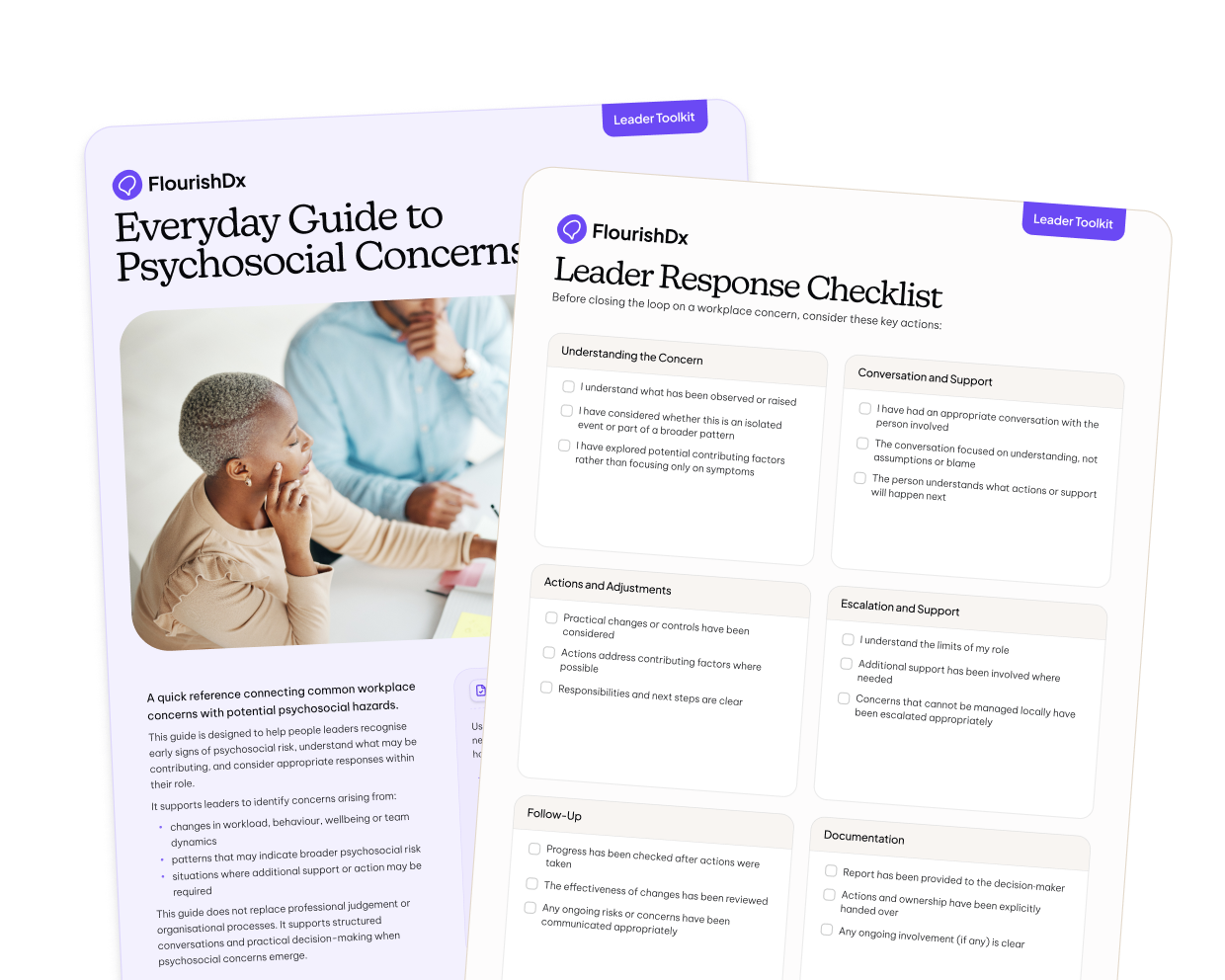
Participants who complete the full program receive a practical resource covering all six competencies, designed for use when real situations arise at work.
The toolkit includes:
- An everyday-language guide connecting common concerns with potential psychosocial hazards
- Conversation prompts to help explore root causes rather than symptoms alone
- A control matrix covering immediate responses and longer-term controls
- Escalation decision trees and trigger points for involving additional support
- Quick scanning exercises leaders can use during busy periods
- Worked scenarios showing how the six competencies come together in practice
Designed and Delivered by Organisational Psychologists
The training is designed and facilitated by FlourishDx organisational psychologists with practical experience in psychosocial risk management, leadership capability and workplace response.
The same team contributes to FlourishDx psychosocial safety eLearning, consulting and specialist training programs, bringing practical organisational experience into each session.

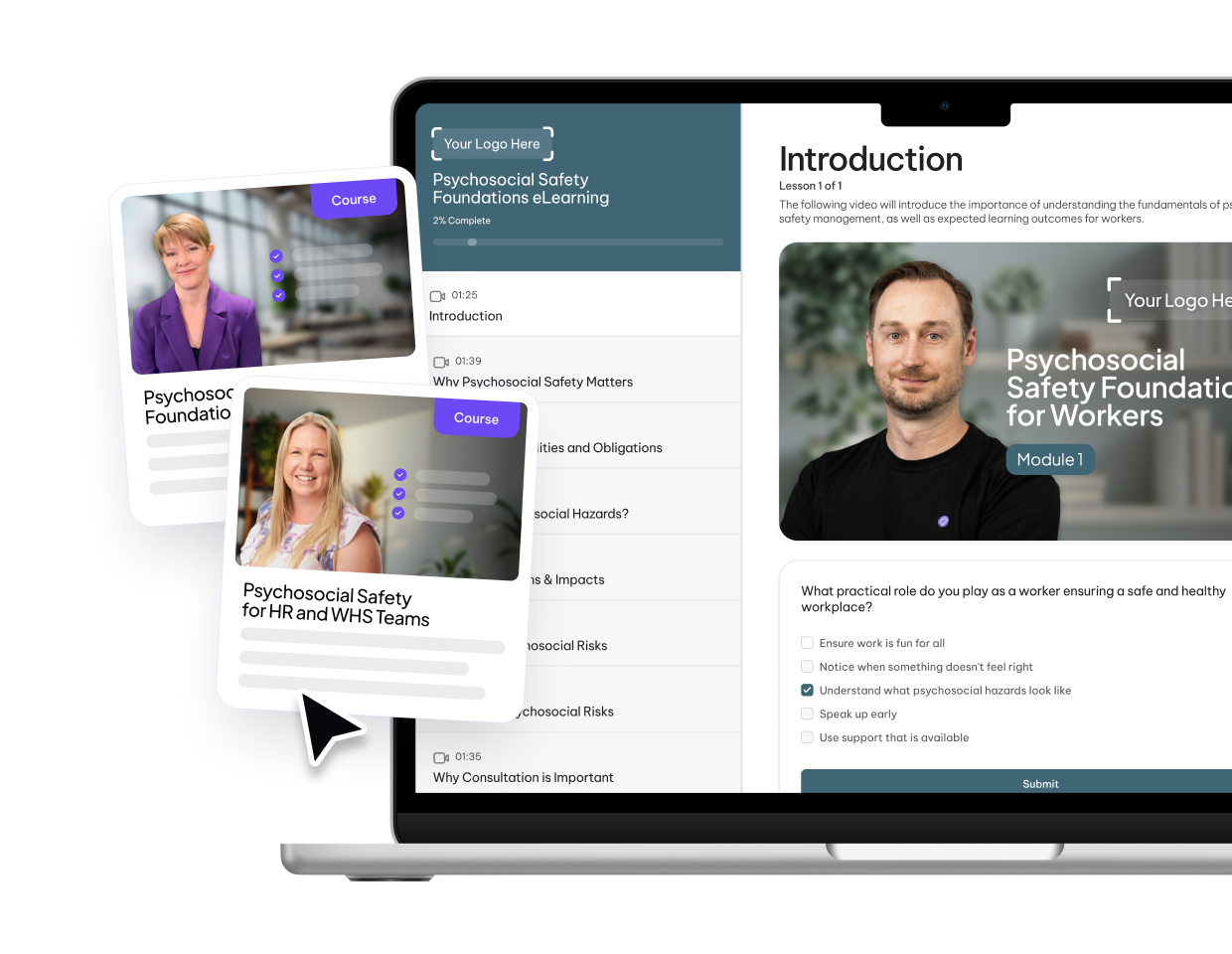
Build the Foundations with Psychosocial Safety eLearning
This training is designed for leaders who already understand the fundamentals of psychosocial safety, including psychosocial hazards, controls, consultation and their general responsibilities.
If that shared foundation is not yet in place, begin with Psychosocial Safety Foundations eLearning before progressing to applied competency training.
Our role-specific eLearning:
- Builds foundational knowledge of psychosocial hazards and risk management
- Covers consultation, controls and leader responsibilities
- Can be tailored with organisational policies and procedures
- Is delivered as a SCORM-ready package for your own LMS
Flexible Delivery
Choose the Format That Works for Your Leaders
Each of the six modules is available in a short 30–40 minute or extended 50–60 minute format. Mix module depth and delivery style to suit your available time and capability priorities.
In Person
Deliver all six competencies in a half-day or full-day facilitated program, with greater opportunity for discussion, practice and peer learning.
Six-Week Virtual Series
Complete one module each week in a one-hour virtual session, giving participants time to apply and practise between sessions.
Embedded
Use individual modules within an existing leadership development program, leadership forum or capability initiative.
Register Now
Build Practical Psychosocial Safety Capability in Your Leadership Team
Tell us about your organisation, leader cohort and preferred delivery format. A FlourishDx specialist can help you understand the available training options and which format is most appropriate.
- Half-day or full-day in-person delivery
- Six-week virtual series
- Individual modules embedded in existing leadership development
- Short and extended module formats available
Launch Sale
20% off
your booking
When you book before 30 September for 2026 delivery
Testimonials
Practical Training Backed by Real-World Experience
FlourishDx training is trusted by organisations looking for practical, credible capability building — not just theory, but guidance participants can apply straight away.
FAQs
Still Have Questions?
If you didn’t find what you were looking for, we’re here to help. Reach out to our team for tailored support or additional information about FlourishDx and how we can meet your needs.
Who is this training designed for?
This training is designed for professionals involved in leading, supporting, or overseeing workplace investigations involving psychosocial safety issues. This includes WHS, HSE and psychosocial safety professionals, HR and People & Culture leaders, industrial and workplace relations specialists, leaders with operational responsibility for investigations, and consultants or advisors conducting investigations. It is especially relevant for those looking to apply a more structured, repeatable, and defensible methodology to psychosocial safety matters.
Do I need prior investigation experience?
Some prior exposure to investigations or complaints handling is recommended. The PSIM Framework and Accreditation Training is not intended as a basic introduction to psychosocial safety. It is best suited to participants who already have some involvement in investigations and want a clearer methodology, stronger decision-making tools, and a more integrated approach to psychosocial matters.
What makes psychosocial safety investigations different?
Psychosocial safety investigations are often more sensitive, complex, and systemically influenced than traditional misconduct or physical incident investigations. The PSIM Framework is designed to help investigators go beyond fact-finding alone by applying a risk-based, person-centred, trauma-informed, fair, and strategically focused approach. That means considering not only what happened, but also the broader work design, organisational context, contributing factors, and ongoing risk of harm.
While ICAM can be useful for some physical incident investigations, it is not specifically designed for psychosocial matters. The PSIM Framework and Accreditation Training is built specifically for psychosocial safety investigations, making it better suited to issues involving cumulative harm, interpersonal dynamics, and broader organisational drivers.
Is this workshop available online as well as in person?
Yes. Participants can attend the PSIM Framework and Accreditation Training in person in selected cities or join an online cohort from anywhere. The online program is delivered across 4 sessions over 12 weeks, making it a flexible option for those who cannot attend face-to-face while still providing access to the same practical methodology, applied learning, and structured investigation framework.
Will I receive a certificate of competence following training?
Following training, there is a short competence assessment activity for participants to do in their own time. Satisfactory completion of this assessment is required to receive the accreditation certificate that certifies that the participant can competently apply the PSIM framework for a psychosocial safety investigation.
What will participants take away from the training?
Participants leave with a practical psychosocial safety investigation framework they can apply immediately, greater confidence in making proportionate and risk-based decisions, and hands-on skills for interviewing, analysing evidence, and reporting findings. They also receive a practical investigation toolkit that includes resources such as triage tools, planning templates, interview guides, analysis frameworks, reporting templates, and follow-up resources to support real-world application. Participants will also receive a certificate of completion for the PSIM Framework and Accreditation Training.
Is the training interactive?
Yes. The training is designed to be highly interactive and hands-on. Participants work through realistic scenarios, applied exercises, and practical decision-making activities across the full investigation lifecycle, from intake and triage through to analysis, reporting, and follow-up. It is built to develop real capability, not just procedural awareness.
Can this workshop be delivered privately for our organisation?
Yes. The PSIM Framework and Accreditation Training can be a strong fit for organisations looking to build more consistent internal capability, strengthen governance, and create a clearer shared methodology for psychosocial safety investigations. Private delivery can also support cross-functional alignment between WHS, HR, People & Culture, Employee Relations, and leaders involved in investigation processes.
Do leaders need to complete any prerequisites first?
Yes. The workshop assumes the foundational knowledge from the psychosocial safety awareness training — what hazards are, what controls are, the hierarchy of controls, and relevant legal obligations — is already in place. The workshop opens with a short refresher, not a foundation, so live time is spent on application. If your leaders still need this foundational knowledge, check out the Psychosocial Safety Foundations eLearning product here.
How is the training delivered?
In person as a half day or full day, virtually as one module a week over six weeks, or embedded as individual modules inside your existing leadership development program.
How long does it take?
As little as 2–3 hours using all short modules, up to a full day using all extended modules. Most clients mix the two, running short modules where leaders are already strong and extended modules where they need the most support.
Is this specific to our industry or our policies?
No. The workshop is organisation-agnostic — built around leader awareness and behaviour, not your specific escalation processes or reporting policies, so it works across sectors without a rebuild
What do leaders take away?
A practical leader resource covering all six competencies, including conversation prompts, a control matrix, escalation decision trees, and quick scanning exercises they can return to after the workshop.
Can this be delivered privately for our organisation?
Yes. This workshop is designed for private, organisation-specific delivery, and can be tailored in module mix, depth and format to your workforce and risk profile.
Does this replace our psychosocial safety eLearning?
No. The eLearning answers “what is psychosocial safety and what do I need to know?” This workshop answers “how do I actually do this in my team?” They’re designed to work together, in that order.